-
 IELTS Topic: SPORTS
Reading 3
Wingsuit’s deadly summer leads to soul searching
Original source: The Guardian

Wingsuit flying has been described as the world’s most exhilarating and dangerous sport. Launching themselves from cliffs wearing a nylon bodysuit, the “wing” being formed by air filling a piece of fabric stretched between the arms and legs, its practitioners glide at speeds of up to 240 km per hour, often skimming close to the ground before eventually deploying a parachute.
But after the sport’s most deadly summer, during which there has been almost two dozen deaths in three months – the vast majority in the Alps, where flying is legal – there is serious concern about it in towns such as Chamonix, below Mont Blanc, and in the Lauterbrunnen area of Switzerland.
The head of the mountain rescue services in Chamonix, Colonel Stephane Bozon, criticised what he described as the recklessness of some fliers.
“We must return to people behaving a little more rationally,” he says.

Chamonix flier Ellen Brennan believes the main problem is overconfidence and complacency.
“I’d have to say that the majority of the accidents have occurred because of the jumper overestimating his or her own abilities,” she said. “Often jumpers become complacent and comfortable at certain jumps leading them to believe they can get away with pushing their limits much further. Unfortunately we are not Superman; we are fragile meat missiles.”
… the majority of the accidents have occurred because of the jumper overestimating his or her own abilities
Nevertheless, wingsuit designer Matt Gerdes is not convinced that wingsuit flying can be regulated. “Regulation is not really possible. Not any more than other mountain sports: alpinism, mountain biking, rock climbing. What we will see is that the public will become more accustomed to seeing wingsuiters die. When 15 people die in an Alpine avalanche, it makes headlines, but people don’t usually cry for mountaineering to be cancelled as a sport.”
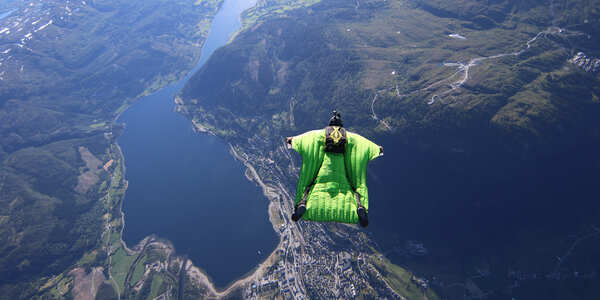
Wingsuit flyers wear a nylon bodysuit; their wing is the fabric that stretches between their arms and their legs. Sinesp/ Shutterstock
Journalist Andrew Bisharat, who has closely chronicled the sport for National Geographic, believes some regulation could have a positive effect. “I think an informal regulation might help. You need a pilot license to fly a plane and you need a motorcycle license to ride a bike. I think having a wingsuit license could help, even if, in reality, it wouldn’t be enforceable.”
We fly because pushing off the edge of a cliff and feeling your wings fill with air … is magic
“There’s a lot of talk in the media this week about danger and death,” wingsuit flier Steph Davis says. “But that’s not why people fly. We fly because pushing off the edge of a cliff and feeling your wings inflate with air, seeing the walls beside you, and the Earth from above, is magic.”